

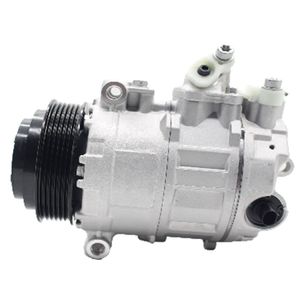
Before ordering an A/C compressor, the decision should not stop at finding an OE number. The buyer should compare the mounting bosses, ear spacing, suction/discharge port position and thread orientation, and the clutch or electrical connector configuration against the existing compressor and the vehicle build data. When these mechanical and electrical details are confirmed before purchase, wrong mounting, hose stress, connector mismatch and return freight are much easier to prevent.
Why an OE Number Alone Still Leaves Fitment Risk
An OE number is the strongest starting point for a compressor inquiry, but it is not a fitment guarantee. Vehicle manufacturers may use different compressor suppliers, change connectors during a model run, or replace an old part number with a supersession that has a different clutch or port layout.
Vehicle Configuration and Production Split
Engine code, transmission type, drive configuration and production date range can all affect which compressor was installed on the same model. A valid OE number for one market may point to a different compressor variant in another market.
- Record the full OE number printed on the old compressor label, not only a short reference.
- Add the VIN, engine code, model year and production month when the vehicle configuration is unclear.
- Confirm the original refrigerant path and compressor family before accepting a cross-reference.
- If the old label is missing, photograph the compressor body and measure the remaining mounting and port details.
Supersession and Cross-Reference Scope
A superseded part number may look equivalent in a catalog but can carry a different electrical connector or port arrangement. Before committing, ask the supplier to confirm the cross-reference against the old label and vehicle application. COOLMASTER is an independent brand and is not affiliated with vehicle manufacturers; vehicle names and part numbers are used for identification only.
“An OE number is a search key. Mounting, port and connector details are the actual fitment check.”
Mounting Points, Ear Spacing and Bracket Compatibility Checks
Even when the OE number matches, the compressor must sit correctly on the engine or bracket. Mounting differences can delay installation and damage threads or the manifold.
Compare Ear/Boss Layout and Thread Details
- Count the mounting ears or bosses and compare their positions.
- Measure ear spacing and bolt hole diameter, and note thread pitch where accessible.
- Check boss depth and whether the old bolts or studs will be reused.
- Document whether the mounting holes are symmetrical or offset; similar castings can still be drilled differently.
Confirm Bracket and Accessory Clearance
If the existing bracket is reused, inspect it for cracks or distortion. A replacement compressor with a slightly different casting shape may require a matching bracket, longer bolts or a different belt alignment. Belt alignment should be checked after installation because a small ear spacing difference can create pulley misalignment and premature belt wear.
Suction/Discharge Port Location, Thread Size and Hose Routing
Suction and discharge ports control hose routing and system sealing. A compressor that looks identical may still force the hoses into a sharp bend or leave the port threads incompatible.
Port Position and Seal Type
- Photograph the old compressor from the port side and the top.
- Note whether the suction and discharge ports are on the same face, opposite faces or offset.
- Record thread size, port diameter and seal type: O-ring, gasket or pad fitting.
- Mark or describe the clocking of each port relative to the mounting bosses.
Hose Routing and Alignment
Original hoses often have limited slack. A shifted port position can create tension, leak paths or contact with the drive belt. Ask the supplier to confirm the replacement port location and orientation before shipping, and compare the replacement part with the old photos before installation.
Clutch, Pulley and Electrical Connector Details to Document
Clutch and connector issues are common even when the compressor body bolts on. A wrong coil connector, pulley width or groove count can stop the repair or create additional parts cost.
Clutch, Coil and Pulley
- Confirm whether the inquiry is for a complete compressor or a separate clutch/coil kit.
- Document pulley diameter, belt groove count and pulley width.
- Check whether the clutch hub spline or keyway matches the replacement compressor shaft.
- If the original clutch is being transferred, compare the hub-to-pulley clearance and retaining hardware.
Electrical Connector and Control Type
For a conventional compressor clutch, record the coil connector shape, pin count, wire length and any diode or thermal protection. For an electric A/C compressor, the high-voltage connector, low-voltage control connector, refrigerant type and system voltage must be confirmed with the exact vehicle and part data; these are not universal across models and applications.
What to Include in the First RFQ So the Supplier Can Confirm Fitment
A complete RFQ helps the supplier confirm fitment in one pass instead of replying with repeated questions. Buyers should send the old compressor label, mounting face, port orientation and connector photos together with the vehicle data.
Fitment Bundle to Send
- OE number and any supersession numbers found on the old part.
- VIN, engine code, model year, production date range and market.
- Photos of the compressor label, mounting bosses, port side and electrical connector.
- Refrigerant type, compressor type and whether the inquiry is for a complete unit or a clutch/coil.
- Any known failure symptoms or previous repair history for the vehicle.
Confirmation Questions to Ask
- “Does the compressor match the original suction/discharge port positions and thread sizes?”
- “Is the electrical connector or clutch type the same, or is an adapter required?”
- “Do the mounting bosses and ear spacing match the existing bracket without modification?”
- “Can you provide a labeled photo of the replacement port side and connector before shipment?”
“A clear fitment request usually prevents the back-and-forth that delays a wholesale order.”
Conclusion: Confirm Fitment Before You Commit
Use the OE number as the search key, then verify mounting, port, thread, clutch and connector details against the old compressor. Photograph the label and key faces, record the vehicle configuration, and request written fitment confirmation before the order is shipped. For compressor fitment requests, send the same bundle to your supplier contact; COOLMASTER can be reached through Tiger Liu at sales@coolmaster.com.cn or +86-18058818382.
常见问题
What should I check before ordering an A/C compressor?
Compare the OE number with the vehicle VIN, engine code, model year and production date range. Then verify mounting bosses, ear spacing, suction/discharge port position, thread size, clutch type and electrical connector against the old compressor. Photos of the label, mounting face, port side and connector help the supplier confirm fitment.
Why can a correct OE number still lead to a wrong compressor?
Vehicle manufacturers may use different compressor suppliers, production splits or market variants within the same model. A superseded part number can also carry a different port layout, clutch or connector, so cross-reference confirmation against vehicle build data is required.
Which photos should I send with a compressor RFQ?
Send the old compressor label, the mounting face or ear bosses, the suction and discharge port side, the pulley or clutch, and the electrical connector. Add the VIN, engine code, model year and production month for complete fitment checking.
Should I order a clutch and coil or a complete compressor?
It depends on the failure. If the problem is limited to the hub, coil or pulley and the compressor body is sound, a clutch kit may be enough. If the failure is internal or the shaft/keyway is damaged, a complete compressor is usually safer. Confirm pulley diameter, groove count, connector and shaft fitment before ordering either route.
Product image from COOLMASTER · 配图仅作产品类别示意,不代表具体车型适配建议
