
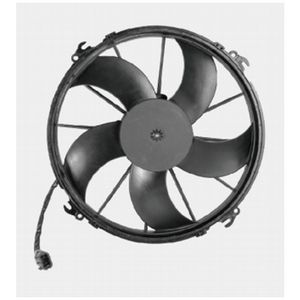
A common complaint pattern is warmer vent air while the vehicle is stationary, followed by stronger cooling once it is moving. Seeing the condenser fan rotating may appear to clear the fan from suspicion, but it establishes only that some fan operation is occurring. It does not establish the commanded operating state, actual airflow quantity, airflow direction, or whether heated air is being drawn back through the condenser.
Fan operation and effective airflow are different measurements
The condenser rejects heat by transferring it from the refrigerant to the air passing through the core. That heat rejection depends on the refrigerant-to-air temperature difference, the condition of the heat exchanger, and the mass of air moving through it. Fan blade motion is only one part of the last factor.
An electric fan may be visibly running at a lower output than the control system requires. Some vehicles use discrete stages, while others use continuously variable control; a simple on/off observation cannot distinguish them. Direction also matters, as do missing or damaged blades, motor performance, shrouds, seals, and obstructions such as debris between heat exchangers. A fan can therefore rotate without delivering its intended flow through the full core area.
The complete air path deserves inspection rather than just the fan itself. A front-mounted condenser commonly encounters outside air before the radiator, although packaging varies. Damaged ducting or front-end seals can permit hot underhood air to recirculate through the condenser. That is an abnormal airflow condition, not an unavoidable result of a front-end layout. Restricted fins and internal refrigerant-side faults must also be kept separate: both can reduce heat rejection, but they do not produce the same evidence.
Why road speed can change the result
A moving vehicle can add ram airflow, meaning airflow produced by vehicle motion through the front opening. Its contribution varies with speed, grille and duct design, heat-exchanger arrangement, and fan operation. When that contribution is removed at a stop, an airflow deficiency that was masked on the road may become apparent.
This is a comparison, not a universal rule. A correctly designed and controlled fan system can provide adequate stationary heat rejection, and idle does not automatically mean lower condenser airflow. The control module may increase fan output at idle in response to pressure, temperature, or another calculated request. Ambient temperature, solar and engine heat load, cabin settings, and control states must consequently be similar before an idle-versus-road comparison is treated as meaningful.
Pressure changes need system-specific interpretation
If condenser airflow is insufficient for the current heat load, the refrigerant generally must condense at a higher temperature to reject that heat. High-side pressure often rises, and evaporator conditions can shift enough to produce warmer vent air. The magnitude and even the apparent pattern, however, depend on how the rest of the system responds.
A variable-displacement compressor can change refrigerant pumping through its control system, while an electric compressor can be controlled by speed rather than by a belt and clutch. Expansion devices, refrigerant charge, fan commands, and pressure or temperature limits also influence the readings. Subcooling—the temperature reduction of liquid refrigerant below its condensing saturation temperature—is likewise affected by system design, charge, metering, and operating conditions. Neither high pressure nor a particular subcooling value proves an airflow fault by itself, and apparently normal pressures do not prove adequate airflow.
Correlate the command, air path, and cooling result
Start by recording vent temperature and the actual test conditions, then compare them with pressures and available scan data under matched, stable operating states. Use vehicle service information to determine the intended fan strategy, expected commands, and acceptable pressure or temperature behavior. Where supported, distinguish a fan-on request from a requested output level and from confirmed actual operation.
Inspect the condenser face, fan and shroud, seals, ducting, and possible hot-air recirculation before assigning the fault to the motor. At the same time, keep condenser airflow separate from cabin airflow: a weak blower, restricted cabin air path, or incorrect air-door operation can change vent delivery without demonstrating poor condenser heat rejection.
If the airflow path and fan response agree with the vehicle data, the remaining possibilities include compressor control, refrigerant metering, charge-related faults, and air-side temperature control. The evidence required to separate them varies by system. A spinning fan combined with warmer stationary vent air is a reason to test the complete heat-rejection path, not sufficient justification to replace either the fan or the compressor.
Product image from COOLMASTER · 配图仅作产品类别示意,不代表具体车型适配建议