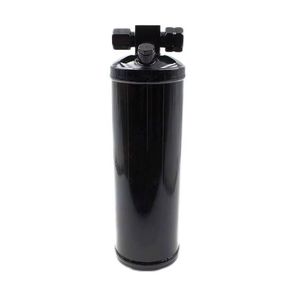
Two housings that technicians replace routinely — the receiver-drier and the accumulator — are among the least inspected parts in an A/C system, largely because nothing about their condition is visible from the outside. Both combine three jobs in one canister: storing refrigerant, filtering debris, and binding water. When the third job fails, the symptoms appear far away from the part itself, which is why understanding what happens inside matters for diagnosis.
Two Designs, Two Positions in the Circuit
The two units belong to different system architectures. A receiver-drier sits on the high-pressure side, downstream of the condenser, in systems that meter refrigerant with an expansion valve. Its housing holds a reserve of liquid refrigerant so the expansion valve stays supplied even as demand fluctuates. An accumulator, by contrast, sits on the low-pressure side, upstream of the compressor, in systems that use a fixed orifice tube. Because an orifice tube cannot adjust to load, liquid refrigerant can leave the evaporator under some conditions; the accumulator catches that liquid and oil before they reach the compressor.
That positioning is the first practical point: the two parts are not interchangeable, and the correct one for a given vehicle is dictated by the metering device and circuit layout, not by appearance. Both contain desiccant and filtration, but what they separate differs — the receiver holds liquid back on the high side, the accumulator protects the compressor on the suction side.
What the Desiccant Actually Does
Water can enter a refrigerant circuit during assembly, during service when the system is opened, or through a leak path while the system is under vacuum during operation. Free moisture inside the circuit is not benign. It can contribute to internal corrosion of steel and aluminum components, it can freeze at the expansion valve or orifice tube — the coldest, narrowest point in the circuit — and it can react with refrigerant and lubricant under operating conditions to form acidic compounds that degrade the system over time.
The desiccant inside the housing is a hygroscopic material that binds water chemically or by adsorption, keeping it out of circulation. While the desiccant has remaining capacity, it continuously removes small amounts of ingressed water. This is why a properly functioning unit protects the whole circuit rather than just its own location: it is the single point where moisture is taken out of the loop.
The Mechanical Roles Beyond Drying
In a receiver-drier, the internal geometry ensures refrigerant leaves as liquid with minimal vapor, maintaining a stable supply to the expansion valve. In an accumulator, internal screens and a pick-up tube carry out the opposite separation: vapor exits toward the compressor while liquid refrigerant and oil are held back and metered back into circulation gradually. This separation is essential for compressor longevity, because liquid slugging and oil starvation are both failure modes the accumulator is designed to prevent.
None of these mechanical functions has an external indicator. Separation performance, internal screen condition, and desiccant state cannot be measured through service ports or pressure gauges.
When the Desiccant Saturates
Desiccant capacity is finite. Once saturated, it can no longer capture incoming moisture, and residual water remains free to promote the effects described above. A saturated or degraded unit can also become a problem in itself: desiccant material can break down, and debris captured by the internal filter can accumulate until flow is partially restricted.
The resulting symptoms are system-wide and non-specific. Metering-device icing, unstable cooling output, or abnormal pressure behavior can each have several possible causes — including a metering device fault, refrigerant charge issues, or airflow problems at the condenser — and none of them uniquely confirms a saturated or blocked receiver-drier or accumulator from outside the part. A pressure reading alone cannot distinguish between these possibilities, and assuming the canister is at fault based on one symptom risks replacing a serviceable component while leaving the actual cause in place.
Service Boundaries and the Moisture Path
Because saturation and internal degradation cannot be verified externally, replacement decisions rest on system history: whether the circuit was opened for an extended period, whether evacuation was complete, whether a leak exposed the desiccant to outside air, and what the vehicle manufacturer’s service documentation specifies. Leaving a circuit open for long periods and incomplete evacuation are common ways moisture enters; specific replacement intervals, refrigerant compatibility, and charge quantities vary by vehicle and must follow the manufacturer’s documentation rather than general practice.
For the technician, the useful takeaway is causal: the desiccant protects every component downstream of it, so a degraded unit is a system risk, not a localized fault. But the same logic limits diagnosis — because the part is hidden inside a sealed housing, its condition is inferred from circuit history and manufacturer guidance, never confirmed from a single symptom or gauge reading.
Product image from COOLMASTER · 配图仅作产品类别示意,不代表具体车型适配建议