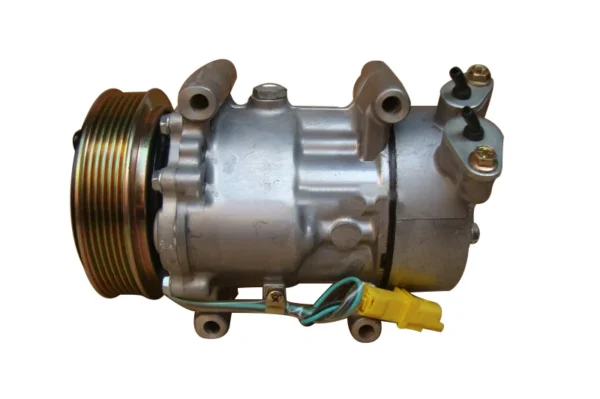
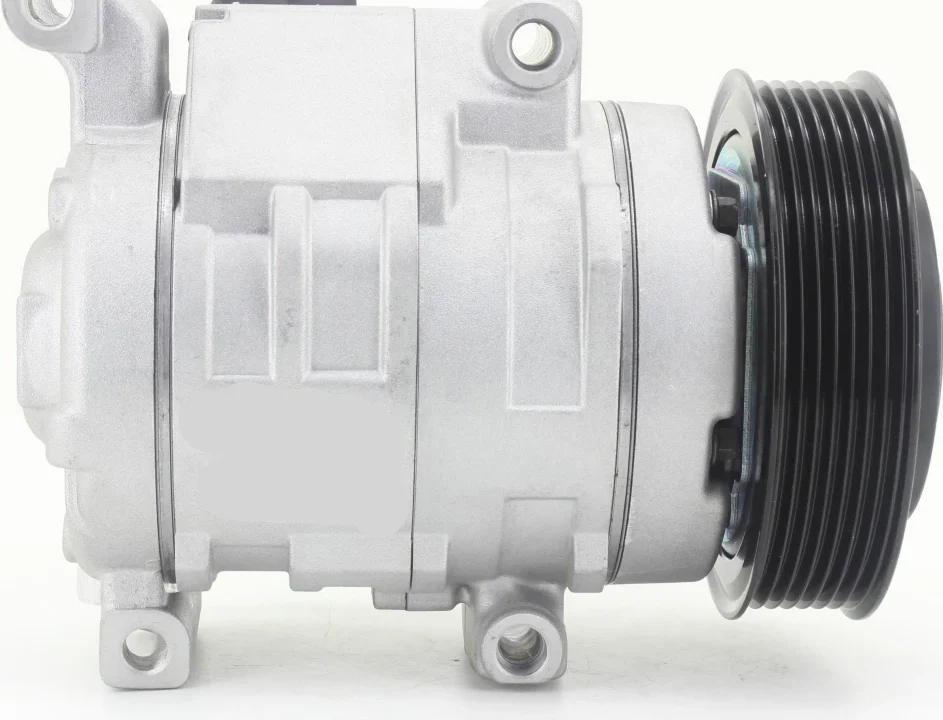
A driver may report that the air conditioning suddenly stops cooling while the engine continues running, and that cooling returns after a restart. Treat that description as illustrative, not as a universal clutch-failure signature. On a clutch-equipped belt-driven compressor, the first technical question is whether the compressor is actually being commanded to engage and, if it is, whether the pulley is positively driving the compressor shaft.
A Belt-Driven Pulley Can Freewheel
With the engine running and A/C requested, the drive belt turns the compressor pulley. On a conventional magnetic-clutch compressor, however, that pulley rides on a bearing and can rotate independently of the compressor shaft until the clutch engages. A stationary field coil is mounted around the pulley or compressor nose. The armature-and-hub assembly is connected to the compressor shaft, normally through splines and a flexible drive plate.
When the coil is de-energized, springs maintain a small mechanical air gap and the pulley freewheels. When the coil is energized, magnetic flux crosses that gap and pulls the armature against the pulley’s friction surface. If the magnetic force and friction are sufficient, the hub, pulley, and shaft rotate together. Therefore, a spinning belt or pulley proves only that the pulley is turning; it does not prove that the compressor shaft is turning. The technician must confirm that the hub locks to the pulley when engagement is commanded.
That architecture does not apply to every system. Some variable-displacement compressors do use a conventional clutch, while clutchless variable-displacement designs may be driven continuously and use a compressor control valve to change pumping displacement. An electric A/C compressor uses an integrated electric motor and inverter rather than a belt-operated clutch.
Missing Engagement May Be a Control Decision
The field coil does not decide by itself when to operate. The A/C request passes through HVAC or engine-control logic, often through a relay or output module. The controller may evaluate refrigerant pressure inputs, evaporator temperature, engine coolant temperature, engine load, throttle position, battery voltage, fault status, and other protection conditions. It may delay, cycle, or completely inhibit engagement because of abnormal pressure, evaporator-freeze protection, overheating, high engine load, or a stored fault.
The fuse, relay, module, wiring, connector, ground, and field coil all form the delivery path between the decision and the mechanical action. No clutch engagement can therefore be a correct system response rather than evidence of a failed coil. A restart may reset a temporary logic state or allow a thermal condition to cool, which explains why cooling can return without proving that the clutch itself was defective.
Scan-tool data and the vehicle-specific circuit diagram are needed to separate these possibilities. If the commanded status is absent or inhibited, diagnosis should follow the inputs and protection logic. If the controller commands engagement but no usable voltage reaches the coil under load, the relay, wiring, connector, or ground is suspect. If good supply and ground reach the coil but the armature does not pull in, attention moves to the coil, air gap, or mechanical clutch assembly.
A Click or Voltage Does Not Prove Torque Transfer
An energized clutch often produces an audible click, but a relay click from under the dash can be mistaken for clutch movement, and a clutch click only indicates that the armature moved. It does not confirm that the friction faces locked without slip. An excessive mechanical gap, weak magnetic force, worn or damaged contact surfaces, contamination, burning, warpage, high circuit resistance, voltage drop, poor ground, or a thermally intermittent coil can allow partial engagement or slipping.
The load side matters as well. A clutch may pull in but cannot hold if the compressor has abnormal internal mechanical resistance or if refrigerant-system pressures create excessive torque demand. A worn belt or tensioner can also slip and create a misleading noise or smell. Voltage measured at an disconnected connector can look normal while the circuit collapses under load, so supply voltage, ground voltage drop, and coil current should be evaluated during the actual failure condition using the manufacturer’s procedure and specifications. A cold resistance reading may identify an open or shorted coil but cannot rule out a fault that appears only after heat soak.
Compare Evidence in the Same Operating Condition
Intermittent complaints should be evaluated while the fault is active, using the same blower, temperature, and A/C settings that produced it. Verify the A/C request and commanded engagement status with scan-tool data where available. Check relay control and output, then measure coil supply and ground under load at the compressor connector. Listen at the compressor rather than assuming every click comes from the clutch. Safely compare pulley and hub rotation, and inspect the belt, tensioner, clutch surfaces, wiring, heat discoloration, odor, and noise.
If there is no engagement command, follow the inhibit inputs and control logic. If the command is present and good supply and ground reach the coil but the hub does not pull in, the field coil or mechanical gap is more likely. If the hub pulls in but slips, compare clutch torque capacity against belt condition and compressor load. If the hub is locked to the pulley but the vent temperature continues rising, the clutch has executed its mechanical function and diagnosis should move to the refrigerant circuit, internal compressor condition, or air-side system.
Know Where Clutch Diagnosis Ends
The same no-cooling complaint can be produced by low refrigerant, abnormal pressure, a metering-device fault, poor condenser airflow, abnormal hot-air recirculation, an evaporator freezing or heat-transfer problem, a restricted cabin air filter, blower or blend-door fault, internal compressor wear, or thermal protection. Reduced cooling normally appears as rising vent temperature, and the cause cannot be assigned from that symptom alone.
Magnetic-clutch testing establishes whether a commanded clutch is transferring torque. It applies only to compressors equipped with that clutch. Clutchless variable-displacement systems and electric compressors require different control and architecture diagnosis, and high-voltage systems require the applicable service information, training, and safety precautions. No generic resistance, gap, voltage, or replacement rule should be substituted for vehicle-specific specifications.
Product image from COOLMASTER · 配图仅作产品类别示意,不代表具体车型适配建议