Many automotive repair technicians encounter scenarios where a customer reports weak A/C cooling, yet the condenser fan is visibly running. This apparent contradiction often stems from confusing fan operation (motor rotation) with effective airflow through the condenser core. Effective airflow refers to the volume of air that passes through the condenser’s fin-and-tube structure to reject heat from high-pressure, high-temperature refrigerant. Visible fan rotation does not guarantee this airflow—several factors can disrupt it, even when the fan is functional.
Shroud integrity is a primary factor here. The condenser fan shroud directs air from the fan into the condenser core; gaps, cracks, or missing sections allow air to bypass the condenser, reducing effective airflow. Bent or damaged fan blades can also disrupt air movement, creating turbulence that fails to push air through the fins. Additionally, at road speeds, ram airflow—air forced into the condenser by the vehicle’s forward motion—supplements fan operation. At idle, when ram airflow is minimal, the fan must handle all cooling load, but if airflow is restricted (e.g., by a blocked grille or hot air reversion from the radiator), even a working fan cannot maintain sufficient cooling.
Condenser placement relative to other front-end components further impacts performance. Most vehicles mount the condenser in front of the radiator, which can lead to hot air recirculation if the air flow path is not sealed. This “hot gas reversion” means the condenser is drawing in already heated air from the radiator, reducing its ability to reject heat. Ambient temperature and system heat load also play roles: higher ambient air increases the temperature difference the condenser must work against, while a higher system heat load (from a variable displacement compressor operating at maximum capacity) requires more airflow to manage.
Diagnostically, technicians should not rely solely on fan operation to assess condenser performance. Instead, verify effective airflow: use a thermal anemometer to measure air volume at the condenser outlet, or perform a smoke test to check for air leaks around the shroud or grille. Compare results to manufacturer guidelines, as acceptable airflow varies by vehicle model and A/C system design. Remember that fan rotation alone is an insufficient metric—effective airflow depends on multiple interconnected components and operating conditions, and weak cooling may stem from airflow restrictions rather than fan failure.
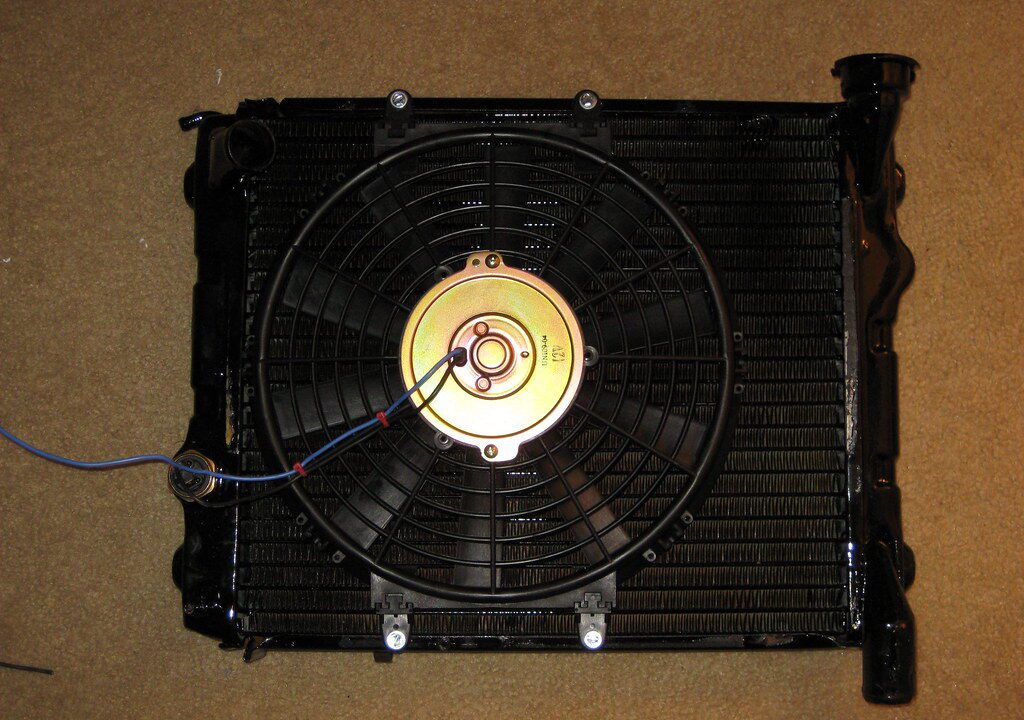
Saab radiator + fan by gull@cyberspace.org · Flickr · CC BY 2.0 · Resized for display; illustrative photo, no endorsement implied.